A photography robot has to do more than move a camera. It must place the lens, light the subject, repeat the shot, and stop when a person enters the work area. For a studio manager, the useful question is whether that control saves setup time without making the process harder to check.
Quick read
- Camera movement matters only when it can repeat the same path and stop at the same point.
- Lighting, focus, and shutter control must work with the robot, not sit in separate systems.
- Safety checks and easy manual control decide whether a robot fits a working studio.
What the robot has to control
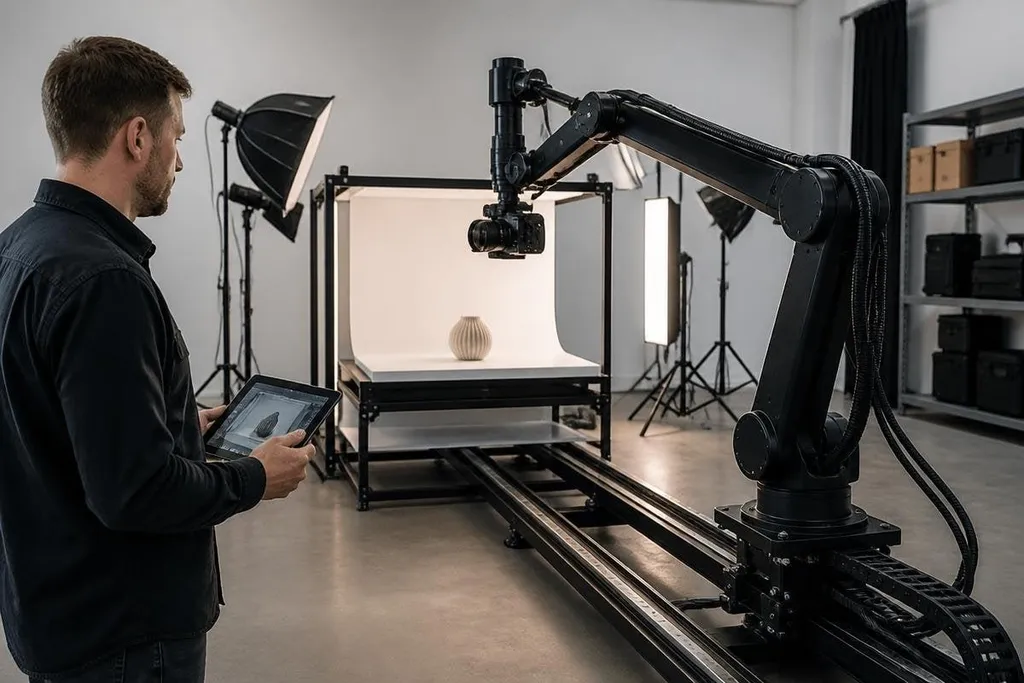
A camera robot usually combines a moving arm or rail with a camera mount. The mount controls pan, tilt, and sometimes lens position, while the robot moves the camera through a planned path around the subject.
That path matters because a small change in camera height or angle can change the look of a product image. A repeatable path lets a photographer create matching images across a product range, which cuts the need to rebuild each setup by hand.
Position feedback matters too. Encoders measure motor movement, while cameras or other sensors can help check the subject and the space around it. Without that feedback, a programmed move may work once and drift when the camera, tripod plate, or subject changes.
The camera is only one part
A moving camera cannot fix poor light or missed focus. A useful photography robot must communicate with the camera, lens, lights, and shutter system so each part follows the same shot plan.
That link can control exposure settings, focus position, flash timing, and image transfer.
The exact setup depends on the camera and software, so compatibility belongs near the top of any buying list. A robot that moves well but needs manual control for every image creates another job beside the first one.
Some shoots also need focus changes during a move. The robot must then keep track of position and timing closely enough for the lens to reach the planned focus point as the camera travels. This is a control problem, not a feature-sheet detail.
A camera robot’s value depends on more than a smooth shot. Robot24.com camera robotics coverage can connect the move, lens control, test date, and operator role. That record matters when you compare a repeatable camera move with the staff time and space it takes to run.
Where photography robots make sense
Repeat work gives these systems their clearest use. A studio producing matching views of many products can save setup effort when one programmed path handles the same movement again and again.
The same idea can help with motion shots, turntable work, and camera moves that are hard to repeat by hand. It can also keep the camera at a fixed distance while the subject changes, provided the robot has enough reach and the subject stays within the planned area.
That does not make the robot a photographer. Someone still has to choose the angle, set the visual goal, check the image, and decide when the result is good enough. The robot handles repeatable motion; the creative decision stays with the operator.
Where the limits show up
A studio with changing floor layouts, loose cables, reflective surfaces, or people moving close to the camera needs more than a saved motion path. The robot must detect obstacles and stop safely, then let an operator recover the shot without rebuilding the whole setup.
Speed also needs care. A fast camera move can shorten a cycle, but it leaves less time for focus, light, and subject movement to settle. A slower path may produce more usable images, even if the robot reaches the next position later.
The open issue is reliability across real shoots. A polished demonstration can show one clean move, while daily work brings new subjects, different lenses, changed light, and small setup errors. Those cases decide whether the robot saves labor or adds supervision.
A buying checklist
Before choosing a photography robot, check these points:
- Camera support: confirm the body, lens, trigger, and image-transfer method.
- Movement range: measure the needed height, reach, rotation, and travel space.
- Repeat accuracy: ask how the maker measures position and how it handles setup changes.
- Safety control: locate the emergency stop and test manual control near the set.
- Shot software: check whether an operator can edit, save, and repeat a camera path.
- Service plan: confirm who fixes the motors, cables, mount, and control computer.
I'd skip any system that can't show how an operator takes control when the shot changes. The next useful proof will be a full shoot with several lenses, changing subjects, and recovery after a stopped motion path, not another isolated camera move.